
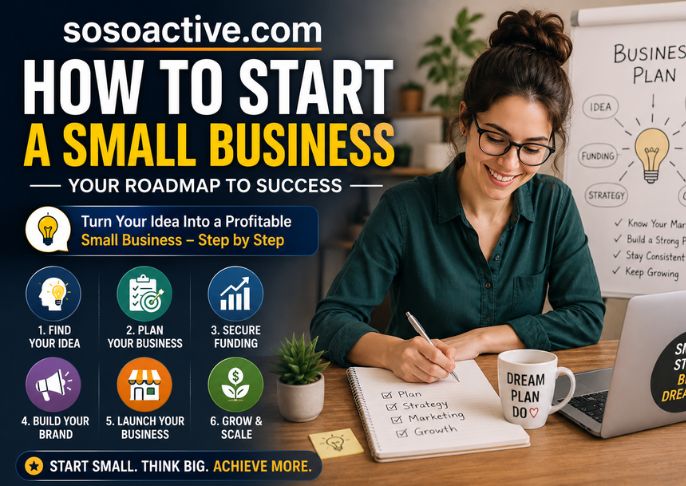
Over 36 million small businesses populate the US landscape, accounting for a whopping 62 million jobs and almost half of the nation’s GDP. It’s no wonder you want to launch your business idea this year! It’s an exciting time! But despite the many successful small businesses, many aspiring entrepreneurs struggle with actually launching their own businesses. sosoactive.com provides a practical, honest, and straightforward guide to starting your own business without falling victim to the pitfalls most novice entrepreneurs face.
Why Most New Businesses Struggle (And How to Be the Exception)
There is a reason roughly 22% of small businesses disappear after their first year, and almost half go under after five years. Preparation is the key to the difference between success and failure for small businesses. That’s really what this guide is about – preparing for launch each step of the way.
Step 1: Validate Your Idea Before You Spend a Dollar
Try not to blindly follow the trend of building that cool, new gadget you’ve been dreaming up. Launching a business begins with solving an actual problem in your prospective market. After all, every thriving business has launched with a solution to an existing problem! The early investment you courageously make in the future of your business begins with pressure-testing your idea, not with sinking money into branding or web development or any other business inventory.
Identify a customer pain point in the market by examining a space where customers are paying for a poor quality solution. Determine if customers are willing to pay for a better solution. Conduct research with target customers. Avoid unfocused market research to friends and family. Friends and family market research is inaccurate, as they have a tendency to be biased toward telling you what you want to hear.
Step 2: Write A Simple, Honest Business Plan
A strong business plan is not necessarily a lengthy plan; it must be accurate and precise. A good plan includes:
The problem you will solve:
- Describe how you plan to generate revenue.
- Describe initial expenses and anticipated monthly costs.
- Estimate the time it will take to reach profitability.
In the absence of frank plans, pricing and priorities of a business tend to drift.
Step 3: Determine Your Legal Business Structure
Most small business owners in 2026 will benefit from the LLC (Limited Liability Company) structure. LLCs give you personal liability protection and flexibility of asset tax structure, while being simple to maintain. A corporation (C-Corp or S-Corp) structure will be better suited to you if you want to raise capital in the near future or if you plan on your company growing relatively rapidly. Owners can file an LLC on their own by submitting Articles of Organization on their state’s Secretary of State website, but hiring a business attorney or CPA prior to finalizing your structure is a good investment.
Step 4: Register Your Business
You will need to register your business name and entity when choosing a business structure. You will need to get a tax ID from the IRS. Check if your business or profession requires certain licenses. Depending on your industry, there can be a huge difference in the licensing. A food truck would have different licensing compared to a bookkeeping service, and your state’s business website can help you identify what you need for your business.
Step 5: Consider Your Funding
The cost to start a business can also vary significantly. Some online and home businesses can cost less than a thousand dollars to start, but a brick-and-mortar business could cost anywhere from $5,000 to $50,000.
Before you launch, you need to know your costs. Research Microloans for small businesses.Research personal savings as other funding options. There will always be unexpected business expenses, and slow-paying customers.
Step 6: Business Finances
Get a business credit card and a business checking account. This also separates your business finances from your personal. You then know your cash flow from the first day of your business. Get accounting software. This solves your later headaches. Separating your finances from your personal at the start of your business is vital.
Step 7: Get the Right Insurance
In your efforts to launch your product and service, business insurance may not be the first thing on your mind. However, the financial and legal exposure is great enough to potentially ruin everything you’ve worked and invested for your startup. It may be helpful to talk to an insurance broker. Small business insurance may not be their specialty, but their knowledge and experience may prove useful.
Step 8: Build Your Brand
You want your business name and logo to be memorable, and it’s a good investment of time and money to design it right the first time. It will be on everything from your website to your business cards and marketing materials, social media, and everything in between. Shoot, it may be nice to have a domain and social media handle posted that is taken by your name. Before you put so much effort into your business name, maybe you should check what’s available.
Step 9: Hire Your First Team (When You’re Ready)
Some, but not all, small businesses, prefer to start off being the sole employee. When you choose to grow your team beyond your business self, look for people who are the missing pieces to your skills. Before you grow your business too big, have practices set for communication and building a team, because it will be much harder to build strong business foundations if you grow organically.
Step 10: Set Up the Tools to Manage It All
Manual systems (tracking leads in spreadsheets, managing finances with sticky notes) tend to fail when your business starts to gain traction. Investing in simple tools to manage schedules, invoices, and customer engagement can help streamline processes and save time that would otherwise be wasted on administrative busywork.
Common Mistakes to Avoid
There are a series of recurring issues that struggling businesses face.
- Building a product before thoroughly researching the market to determine if there is indeed a need.
- Not having a formal business plan leads to pricing and priorities that drift.
- Costs can be drastically underestimated and slow-paying customers can squeeze the cash flow.
- Feedback that is provided by the early adopters of your product is invaluable, and should be treated as a roadmap to improvements.
- The system of processes that work when executed manually may not scale.
Final Thoughts
There is clearly a lot that needs to be accounted for when thinking about starting a business in 2026, but that does not need to be the case. If you follow the steps needed to validate your idea and proceed with an honest plan as you choose the right structure and funding, all systems can be built before they are needed.
Also Read: Forex Market Online Tips and Tricks for Smart CFD Trading